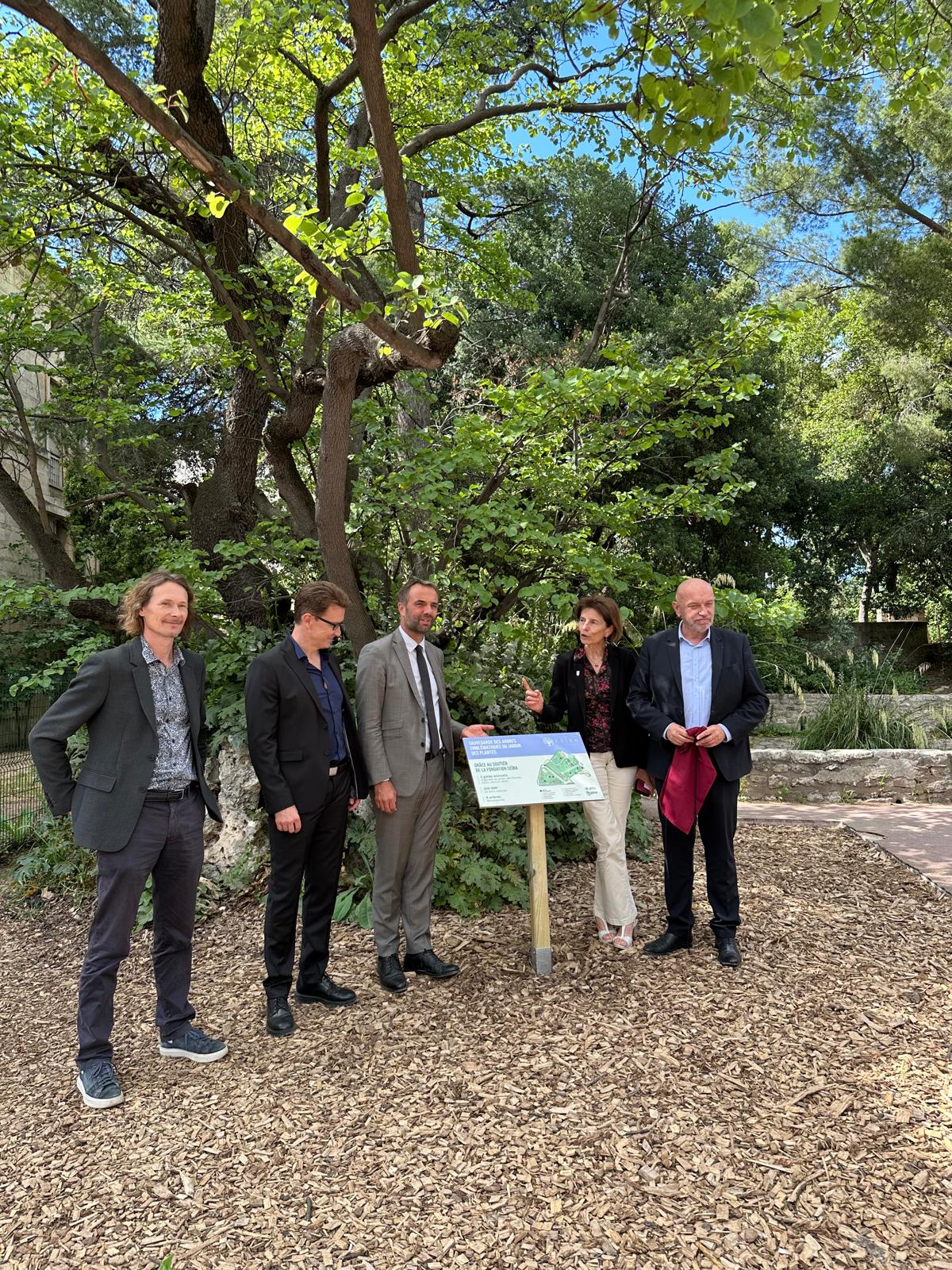
This Thursday, May 22, Michaël Delafosse, mayor of Montpellier, Nicolas Chambon, president of the Ceïba Foundation, Philippe Augé, president of the University of Montpellier, and Isabelle Laffont, dean of the Faculty of Medicine, participated in an official visit to the Montpellier Jardin des Plantes. This meeting marks the completion of a major project: the safeguarding of nine emblematic trees of the Montpellier Plants Garden, carried out with the financial and technical support of the Ceïba Foundation.
Founded in 1593, the Montpellier plant garden is the oldest botanical garden in France, having served as a model for that of Paris. From the 16th century, it was distinguished by its remarkable biodiversity, by combining local and exotic species in various natural environments. Classified “under the sites (12/02/1998) and the historic monuments” (03/09/1992), it extends over an area of 4.7 hectares. The Jardin des Plantes is confronted with several challenges, including climate change, overcrowding and aging of its wooded heritage. Through the three annual galas organized by the Ceïba Foundation between 2022 and 2024 at the Montpellier Plants Jardin, more than 250,000 euros were collected thanks to the generosity of many donors, making it possible to support the actions to safeguard and preserve trees.
The funds have made it possible to carry out in -depth scientific diagnostics in order to better understand the health issues affecting the trees of the Montpellier plant garden. These expertise made it possible to establish a specific inventory and to determine the necessary interventions to preserve these trees. The Ceïba Foundation, in partnership with the Inffe and Agrene research centers, as well as with the help of landscapers experts from the Foundation, Alain and Léo Marguerit and Bruno Ricci, were able to identify several urgent actions for the protection of nine emblematic trees in suffering. Among these are the Tree of Judea (Circis Siliquastrum) planted in 1604 by Pierre Richer de Belleval, and the Ginkgo (Ginkgo Biloba) of the System School planted in 1795 by Antoine Gouan. These trees, representative of the botanical heritage of the plant garden, required immediate care to ensure their long -term preservation.
Between February 3 and 14, 2025, the Angle Vert company intervened to carry out soil decompacting operations around these nine remarkable trees. A first technical visit had been carried out with the presence of John de Vos, professor and director of the Jardin des Plantes, Emmanuel Spicq, Chief Culture of the Jardin des Plantes, the Expert of the Ceïba Léo Marguerit Foundation, as well as Green Angle teams, in order to establish a specific action plan for each of the trees concerned. The main objective was to improve the living conditions of trees by working on the quality of the soil: decompacting, contribution of substrate and implementation of mulch. The high frequentation of the site had compacted and impoverished the soil at the foot of the trees, jeopardizing their survival. In total, more than 300 m² of soil have been renewed in order to guarantee the safeguard of this precious natural heritage for the inhabitants of Montpellier and future generations.
Montpellier plant garden
Sources: press release
Travel Source
Discover the world easily and comfortably with Merpati Airlines. From comprehensive travel guides and dream destination recommendations to practical tips, we provide everything you need to plan the perfect trip. Explore exotic locations, find the best deals on flights and hotels, or uncover travel packages tailored to your style. With interactive maps, traveler reviews, and authentic local insights, we’re your trusted travel companion. Start your adventure today!