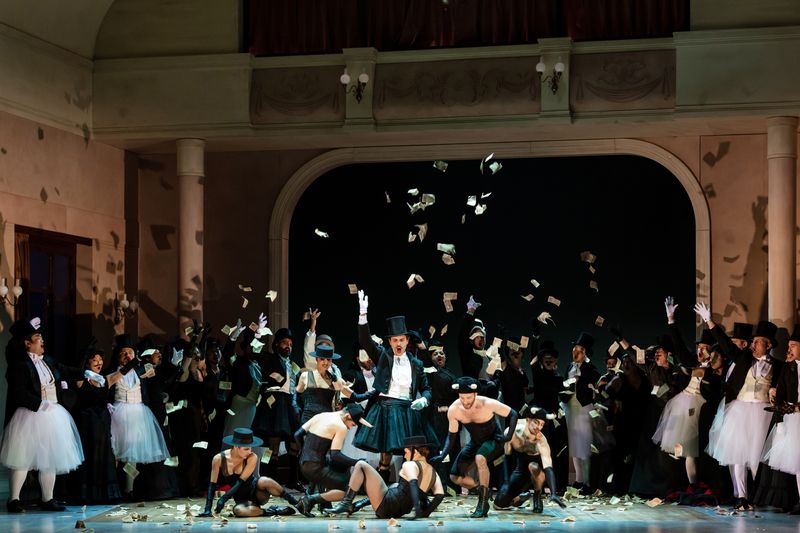
Silvia Paoli transposes La Traviata by Guiseppe Verdi in a theater setting, with Violetta Valéry, who has become an actress, in the main role. The question of representation is at the heart of the plot and the social tension is accentuated by the staging.
Violetta gets lost in the whirlwind of the party, but love in the form of Alfredo Germont, a young man from a good family, makes her abandon her worldly and comfortable existence. Giorgio Germont, the father, guarantor of family values, is opposed to this union.
Horrible loneliness
Guiseppe Verdi (1813-1901) attended the Parisian performance of the adaptation of the novel The Lady of the Camellias by Alexandre Dumas fils. At this period, he himself was under the pressure of social conventions, because he lived non-marital with Guiseppina Strepponi, a singer – whom he married in 1859. She recognized herself in the life of Alphonsine Duplessis, a demi-mondaine abandoned by everyone and who died of tuberculosis at only twenty-three years old. Verdi creates La Traviata in 1853 – literally “the Misguided” or “the lost” -, on a libretto by Francesco Maria Piave. The very demanding role of Violetta Valéry is played by soprano Ruzan Mantashyan. The character develops a broad vocal spectrum, requiring great coloratura and dramatic soprano qualities, to translate emotions and dramatic intensity.
In a Theater, as close as possible to the factory of illusions, Violetta is an actress-courtesan from the end of the 19th century, in search of recognition. The tuberculosis from which she suffers takes a back seat. “ Violetta’s real illness is the horrible loneliness that was imposed on her and the despair of having seen the whole of society turn its back on her. », specifies Silvia Paoli who directs the production.
Roderick Cox conducts the score of this famous opera with its inventive melody for the first time. He wishes to favor the feeling of intimacy until the ultimate return of the prelude.
At the opening, Violetta dressed in a white shirt dances painfully to the sound of the duality between love and death. In the first scene, the party is in full swing, the actress is surrounded by ballerinas and suitors. The dancers exchange costumes and gendered appearances, but at the last curtain fall, it is the patriarchal society that wins, and tramples Violetta.
Social violence
After the declaration of Alfredo Germont – the tenor Omer Kobiljak –, Violetta pulls herself together and proclaims always free : “ Yes, I must be free, frolicking from joy to joy. I want my life to be spent forever on the paths of pleasure. »
At the beginning of Act II, Violetta has given in to Alfredo’s sincere love and both live in the countryside. But Giorgio Germont – Gëzim Myshketa – arrives in this peaceful retreat, and demands separation from his son. Their scandalous relationship harms his family’s reputation, and prevents his daughter’s marriage. In this exchange, the reality of relations of domination comes to light. This social violence is painfully felt for Violetta, condemned to sacrifice.
Silvia Paoli is not convinced by the character of Giorgio Germont, defender of family honor and showing compassion. It highlights the hypocrisy and assumed cowardice, like the corseted society of the end of the 19th century. Appearances are therefore kept in line with his discourse on respectability, and an alleged promise of spiritual heritage. Violetta leaves Alfredo without informing him of the reasons for her breakup. He makes him pay for it with public humiliation.
At the Theater, Violetta is always within sight. The Choir represents society. It is tolerated but not accepted: “ She painfully gained her independence, recalls Silvia Paoli, but she does not manage to free herself from the judgment of the society around her, of the bourgeoisie which is so powerful, patriarchal and bigoted. »
Fatma Alilate
La Traviata by Guiseppe Verdi
Comedy Opera, Montpellier
Created on March 6, 1853 at La Fenice in Venice.
Booklet of Francesco Maria Piave based on the novel byAlexandre Dumas son, The Lady of the Camellias.
Staging Silvia Paoli
Musical direction Roderick Cox
Decors Lisetta Buccellato ; Costumes Valéria Donata Bettellacostume assistant Claudia Furlan ; Lights Fiammetta Baldiserri ; Assistant director Thécla Gucci ; Choreography Emmanuelle Rosa
With Cunning Mantashyan (Violetta Valéry), Omer Kobiljak (Alfredo Germont), Gëzim Myshketa (Giorigio Germont), Sung Eun Myung (Gastone), Aurore Ugolin (Flore Bervoix), Séraphine Cotrez (Annine), Yuri Kissin (Baron Douphol), Maurel Endong (Marquis d’Obigny), Thibault of Damascus (Doctor Grenvil), Hyoungsub Kim (Guiseppe), Xin Wang (a servant), Jean-Philippe Elleouët (a commission agent)
Dancers: Aura Calarco, Fabio Caputo, Melissa Cosseta, Nicola Manzoni, Armando Rossi
Choir National Opera Montpellier Occitanie National Orchestra Montpellier Occitanie
Sung in Italian with French subtitles, 2h30
Photographs: La Traviata / Anger Nantes Opera © Delphine Perrin
Travel Source
Discover the world easily and comfortably with Merpati Airlines. From comprehensive travel guides and dream destination recommendations to practical tips, we provide everything you need to plan the perfect trip. Explore exotic locations, find the best deals on flights and hotels, or uncover travel packages tailored to your style. With interactive maps, traveler reviews, and authentic local insights, we’re your trusted travel companion. Start your adventure today!