
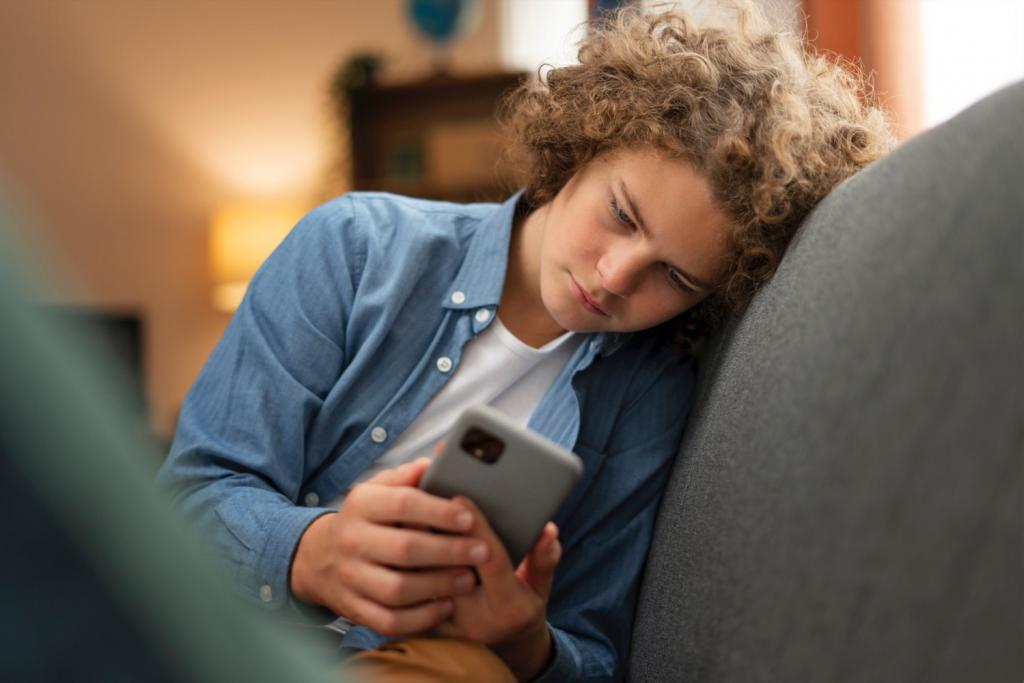
From post-confidence to the excesses of social networks through eco-anxiety, the morale of young people is at half mast. How to recognize their discomfort and take care of them? We talk about it on the occasion of mental health week from October 6 to 12.
The figures on the mental health of young people are disturbing. According to Sciensano, the Belgian Health Institute, suicide is the leading cause of death among Belgian young people. “Without forgetting that there are 18 to 20 times more suicide attempts than successful suicides,” adds psychologist Florence Ringlet, therapeutic director of a pass in the dead end, a mental health association specializing in suicide prevention.
Depression figures are just as arresting. According to the Ipsos barometer, on the morale of adolescents, 40% are potentially affected by more or less severe depressive symptoms. As for mental disorders (anxious, bipolar, post-traumatic, schizophrenia or food disorders), they would concern, according to UNICEF (figures of 2022), more than 16% of Belgians aged 10 to 19.
Too much stimuli
According to Florence Ringlet, the causes are multiple, forming a complex backdrop. “The biggest challenge for young people in my opinion is the confrontation with the mass of information on an extremely short time. They have too much stimuli. This is also the case for adults. But in young people, this stimulation has an all more harmful effect. There are so many communication networks that it generates a constant fear of missing something. It is a permanent assault.
Internet and networks give a truncated vision of reality.
The problem is also that young people are faced with information that they are not always ready to receive. “As a parent, we cannot always check what they have access to, so it is more complicated to protect them. In case of harassment for example, the young person has no respite. And then there is a loss of bearings. Internet and the networks give a truncated vision of reality: they see Youtubers with a so-called perfect life and take this for cash.”
Impact of COVVI
Finally, even if the pandemic and confinement are far behind us, their impact is always very present. At the time, there had been an upsurge in calls for young people who felt anxious, anxious, depressed. While the majority did not present mental health problems before.
Containment measures have undergone the basic needs of the young person.
“Confainment measures have undergone the younger needs of the young,” explains the shrink. Above all, above all, register in a social fabric. We are all social beings, but for young people, this aspect is a necessity, which allows them to develop their cognitive faculties. By confronting others, they learn to regulate their emotions, to build their identity. ”
Among other needs, the psychologist evokes the need for confidence (in the future and the other), to be heard, recognized, to feel safe, empowered, and to feed projects.
Eco-anxiety affects 48% of young people
The future precisely, let’s talk about it. “Whether at the economic, socio-political or environmental level, the future prospects are uncertain. And this uncertainty is very scary for young people,” says the psychologist. The eco-anxiety thus affects 48% of young people, according to an Ipsos survey published in 2023. “This eco-anxiety manifests itself by a variety of emotions. Fear, faced with the threat of global warming and natural disasters. But also, sadness, anger or a feeling of helplessness. Hence the importance, as a parent, to show them what they have what they have what they have. helplessness is very harmful to mental health. ”
5 signs of discomfort in teenagers
So how do you know if your teenager is doing well? The psychologist pinpoints attitudes that can help us sound the alarm.
- Fallowing down: The young person adopts unusual behavior, he speaks less, becomes mutic.
- Somatic complaints: Headache, belly, sleep disorders, change of appetite … For example, the young person refuses to go to school because of this or that pain.
- Anxiety: The young person develops a whole series of fears that he did not have before.
- Hyperconnection: He can no longer get his smartphone or computer.
- Self -disgust: He can no longer bear to see himself in the mirror or in photos, no longer wants to take care of him.
The answer is in a few keywords:
- Communicate. Talking with your child, opening a benevolent discussion.
- Confide. Dare to talk about yourself, your own problems as a parent. This does not mean that we must unload them on our children. But it is important to show them how we manage to overcome obstacles, to give them benchmarks.
- Recognize. Do not minimize or trivialize what he lives/his discomfort. Tell him that we are worried about him, that we can see that it is not going well. That we will find solutions, together.
- Ask for help. Many associations are available to parents and young people. You can notably call 103, listening service (special young-children and teenagers); The 116,000, Child Focus (online security, abuse, disappearances) and 0800 32 123, listening line of the suicide prevention center.
You will also like:
Recipes, fashion, decor, sex, astro: follow our news on Facebook and Instagram. Excluded: our latest items via email.
Travel Source
Discover the world easily and comfortably with Merpati Airlines. From comprehensive travel guides and dream destination recommendations to practical tips, we provide everything you need to plan the perfect trip. Explore exotic locations, find the best deals on flights and hotels, or uncover travel packages tailored to your style. With interactive maps, traveler reviews, and authentic local insights, we’re your trusted travel companion. Start your adventure today!