Being a digital nomad is so often called “the dream”.
With the rise of remote work over the past few years, the allure of working from anywhere has hit peak fever. Waking up in Bali, working from a chic café in Lisbon, and wrapping up the day on a beach in Thailand seems like the ultimate lifestyle.
But as ever, beneath the envy-inducing ‘today’s office’ Instagram stories, there’s another side to this lifestyle that rarely gets talked about: the cons of being a digital nomad.
As someone who’s bounced between countries with a laptop as my constant companion, I’ve learned a thing or two about the less glamorous side of being a “digital nomad” and remote worker.
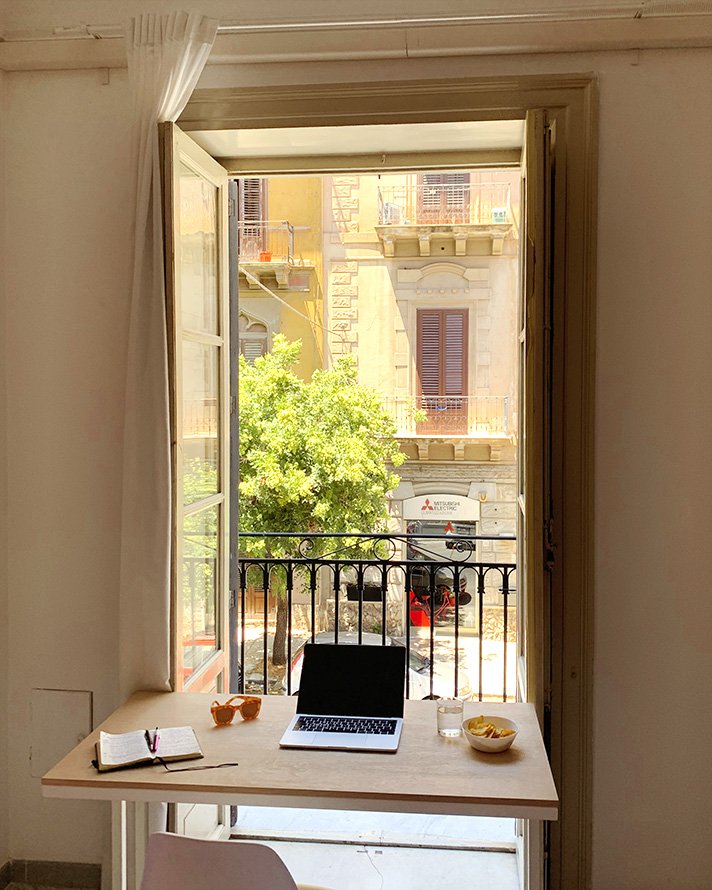
 Working remotely at a café in Palermo, Sicily
If you’re already living the nomadic life or thinking about taking the plunge, you’ve likely considered the benefits. But the downsides deserve some serious thought, too.
Honestly, I’ve lived through a lot of the ups and downs myself, even before the phrase “digital nomad” hit mainstream popularity.
So here’s a closer look at the cons of being a digital nomad – and if you’re either wanting to take on this life or currently already are – some of my personal tips to help make them a little easier!
The Cons of Being a Digital Nomad: 11 Downsides To Think About

Hiking Mount Batur in Bali at sunrise
1. You Take on Entrepreneurial Risk
Owning a business and working for yourself can be exhilarating, but it’s not for the faint-hearted.
When you’re self-employed or running your own thing, that “guaranteed paycheck” feeling goes out the window. Some months, you’re thriving with more work than you can handle. Other months, clients ghost you or payments are late, but your rent and bills never take a break.
As it is when you’re a freelancer, there’s a challenging dance to both keep and retain clients while also trying to preserve your boundaries. Once you become a digital nomad, entrepreneur or run your own business, the financial aspect of this becomes even scarier.
There’s always a level of risk involved in being self-employed.
If you’re going to commit to digital nomad life, you should have a strong awareness of your risk tolerance. Unless you’re employed with a monthly paycheck, there’s no set amount you’ll be earning.
What I’ve learned is that planning is everything. If you’re not a numbers person (which I’m not), it can feel so daunting – but I always recommend writing down your expenses and knowing exactly how much you need to make ends meet each month. Forreal. Face the music and factor in everything you spend money on, from health insurance to rainy-day funds.
This approach kept my anxiety in check when things got rough. So did getting good at building side hustles and passive income.
Smart Tip: Build a solid emergency fund – enough to cover at least 3–6 months’ expenses – before you go all-in. Test your business as a side gig before you quit your job.
Choosing a home base in a country with good support systems can make the transition less stressful when you’re just starting out. That’s why I chose to move to Manila.

2. The financial uncertainty gets real
Unlike traditional jobs with steady paychecks, digital nomads often juggle freelancing gigs or remote contracts that don’t always guarantee consistent income.
If one client suddenly drops you or a new project doesn’t pan out, it can leave your finances uncomfortably tight. Add in the temptation to splurge on experiences (a scuba-diving trip here, a fancy jungle safari there), and you might find yourself on a financial rollercoaster.
Before I went fully remote, I sort of knew it could get unpredictable – but I wish someone had told me just how rocky it could get. In your early twenties, being a little broke is charming. When you’re in your thirties, it’s terrifying.
There are also a lot more financial demands on you depending on where you’re at in your life. As a creator and a blogger, I have fixed outgoings that are non-negotiable – website hosting costs, editing software subscriptions, invoicing app costs. All of these are business-critical – and that doesn’t even include my personal bills, which covers everything from mobile bills to contact lens subscriptions.
If you grew up with financial insecurity, and you don’t have any emotional or financial safety nets, this sort of lifestyle can feel doubly stressful if you’ve not got savings.
I’m no stranger to an erratic paycheck. This really is the payoff – occasional financial instability where you’re suddenly racked with anxiety about the next month’s rent or bills. My number one piece of advice: save, little and often, if your next paycheck isn’t guaranteed. I’ve learned to stash away a safety net whenever I can and lean into passive income wherever possible (check out my post on passive income for more tips).
Plus, don’t forget those sneaky “nomadic” costs – overpriced coffee in tourist hotspots, international ATM fees, and last-minute flight changes when plans fall apart.
How to Stay Financially Secure
- Have an emergency fund. A cushion equivalent to 3 to 6 months’ living expenses can be a lifesaver during income dips.
- Track spending. Apps like Emma can help you manage your expenses and avoid overspending.
- Diversify income streams. If one line of work dries up, having backup sources of income (especially passive income – such as blogging, online courses, or affiliate marketing – can provide much-needed cushion.
3. You’re fully responsible for all your money and medical matters
Hand in hand with entrepreneurial risk is the reality of managing every part of your financial life.
I’ve been self-employed on and off since I was 21, over a decade now, so I’m comfortable and aware of how to manage entrepreneurial risk, but it doesn’t mean it’s not tough.
When you’re a digital nomad, you’re your own HR, accountant, and retirement planner. Woo! That means tackling taxes, buying the right insurance, keeping your books in order, and saving for the far-off future.
I cannot stress enough how important it is to assess any medical issues you might face, and to sort your health insurance or travel insurance before you hit the road. You won’t have the luxury of being around the doctor you grew up with, or if you’re from the UK like me, popping to the pharmacy to pick up an over-the-counter prescription that’s largely subsidised by the NHS.
Medical bills abroad can be eye-watering. Picking a country with affordable, reliable healthcare as a base (at least for a while) gives serious peace of mind. My recommended travel insurance supplier is SafetyWing, as they’re an insurance company designed for digital nomads, by digital nomads.
The same goes for retirement and income tax.
Make it a habit to stash away a percentage of every payment for taxes and long-term savings. I learned this lesson the hard way after getting slapped with an unexpected tax bill. The multiple zeroes had me clutching my chest. Luckily an accountant helped me work through it.
Quick Advice: Set reminders for filing deadlines, research tax obligations (especially if you’re bouncing between countries), and consider chatting with a professional accountant. If budgeting isn’t your thing, there are some fantastic, fun, genuinely useful budgeting apps out there like Emma to help you stay on top of it.
4. It’s easy to underestimate how much work you’ll have to do
Your Insta pals might suggest you’re always on a hammock with a marg in hand, but the real digital nomad life?
You’ll likely work more – especially at first. Building a freelance business or content platform isn’t a 9-to-5 grind, it’s a “whenever the work comes in” hustle. It’s a 9-to-5 AND a 5-to-9 unless you get really, really good at boundaries.
I learned this early on. During my first year, I clocked in countless hours pitching clients, meeting deadlines, and building my brand from scratch, all while navigating spotty Wi-Fi and new time zones. I’d be up at odd hours because that’s when clients, based in the UK, EU or US wanted to chat. To be honest, I’m still doing this!
The trick is to work smarter, not just harder. Find projects with the potential for passive income (like affiliate marketing – my post on passive income breaks this down!), and automate what you can. I recommend TravelPayouts if you have a travel blog. Also, if you’re hosted on one of those drag-and-drop sites, here’s why I recommend migrating your domain to WordPress (hint: it’s way more profitable).
Either way, expect to put in the hours at the start.
If you’re in a similar field to me (production, creation, strategy) then you’ll be making decks, pitching clients and doing outreach. All of this is work on top of actual delivery work. The work doesn’t end! That’s why it’s important to diversify your revenue streams. Fiverr kept me afloat for the first 3 years of my digital nomading.
Pro Tip: Prioritise tasks with lasting impact on your business, even if they don’t pay off instantly. Build systems now to make your future self’s life easier.

Smiling on the beach of Daku Island in Siargao with friends I met on a surf group trip
5. Missing your community back home
Something that doesn’t get talked about enough is the ache for a real, in-person community. It’s one of the biggest cons of being a digital nomad – the clue is in the name.
As a creative with deep roots in London and Filipino heritage, I’m lucky to be embedded in creative circles, cultural groups, and all sorts of communities. In London, I’ve always had folks nearby – family, close friends to call for a spontaneous cinema trip, mates with sofas to catch up on, and people to grab coffee or just have a chat with when the mood strikes.
Going nomad meant I’ve felt that absence more than I expected. There’s no substitute for in-real-life moments and events – going to celebrate a friend’s birthday, bumping into someone in the shop, or just popping round to a mate’s for dinner when the world feels overwhelming (which, let’s be honest, is more often lately with everything going on from the climate crisis to… well, the relentless news cycle). It’s made it really hard for me to leave London for good.
The older I get, the more I realise how much community is everything.
Online groups and digital chats can’t fully replace the warmth and support of your people right there with you.
On the plus side, you’ve got a chance to start building your own new community wherever you are. And on that note…
6. Loneliness can creep up on you, big time
When you’re travelling solo from one country to the next, the initial excitement of new surroundings can quickly morph into feelings of isolation.
Sure, you’ll meet plenty of people in co-living spaces, hostels, or co-working hubs. But these connections can be fleeting, everyone’s on their own schedule, and before long they’re off to their next destination – or they’re not really your cup of tea.
The loneliness hit me hardest during my stint in Manila. Even though I was surrounded by “my culture” and having this life-changing experience working in my motherland (and learning more about my roots!), I felt lonely and disconnected from so many of my friendships. All my friends were building lives in London, and catching up meant that extra effort to schedule a Skype or FaceTime. I have no regrets whatsoever – travelling through South East Asia solo taught me so much about myself, but there were a lot of meals for one.
It can get tougher when birthdays or important events come around, and you realise your nearest and dearest are miles (or oceans) away.
And then there was that time in rural Valencia, where I was recovering from Covid. The landscape was gorgeous, but my mental health was on the floor. Once again, the loneliness crept in.
At the same time, I did appreciate the freedom to reconnect with myself – so it’s not all doom and gloom, just very real. We’re all human.
How to Dodge the Loneliness Trap
- Join communities tailored to digital nomads. Facebook groups or apps can help you connect with like-minded people.
- Slow down your travel. Staying in one place a little longer allows you to build deeper relationships with locals and fellow nomads.
- Maintain your relationships back home. Regular video calls with family and friends can do wonders for your mental health.

Remote working from a balcony in Valencia, Spain
7. You can struggle to find stability
Swapping a fixed address for a nomadic life means you’ll rarely wake up in the same place for long. While this sounds exhilarating at first, the lack of stability can become overwhelming.
Packing and unpacking your life every few weeks can feel exhausting. I’ve lost count of how many times I’ve packed and unpacked a suitcase.
Add to that visa worries, logistical nightmares, and the challenge of finding reliable Wi-Fi – it can all get a bit chaotic.
The whole Wi-Fi struggle is all too real. When I was working remotely with a UK agency from the Philippines, there were countless times I reaaaally struggled with decent connection on Zoom or Teams calls.
Sometimes it was the Airbnb, others it was the entire city!
On top of that, the timezone difference was brutal – I often started my day wanting to explore but found myself working until midnight or 1am to sync up with my team. Just this May, Japan had me working on French time – between the jet-lag and the time differences, I was constantly underslept.
This is actually important to consider depending on what kind of job you do. If you’re client-facing, imagine a scenario like: you’ve got a major client presentation first thing in the morning, but the power in your Airbnb just went out, and the local coffee shop doesn’t open till 9 a.m. Stability? Non-existent. In these instances I’ve learned a portable wifi and local eSim are the answer. Gamechanging!
How to Find Some Stability in the Chaos
- Use a travel schedule that lets you plan ahead. Knowing exactly where you’ll be in two or three months helps reduce the stress of constant decision-making.
- Research stays and coworking spaces known for reliability and strong wifi. Websites like Nomad List are great for this.
- Build routines wherever you land, from morning rituals to regular gym visits. Familiar habits offer a comforting sense of control.

Taking a photo with my Sony A7iii in Antique Island, Philippines
8. You often work without a routine
Not having a routine can throw even the most adventurous traveler for a loop. As much as I love the freedom, having no familiar rituals or daily structure means even small tasks can feel overwhelming.
In Valencia, surrounded by orange groves and beautiful countryside, I realised how much I missed simple habits – going to my favourite coffee shop, having London banter, going to the gym.
Sometimes, all that spontaneity comes with an emotional tax.
The upside? You can define your own routine – maybe that means spending a month or two in one place or just carving out little rituals wherever you roam.
Routine Hack: Try to hold onto a couple of small daily habits (like morning journaling or evening walks), regardless of where you are. It provides an anchor – even if everything else keeps changing.
9. Work-life balance gets extremely blurry
When your life looks like one long holiday, it’s easy for work to seep into every part of your day.
You might find yourself replying to emails at 10 p.m. or brainstorming ideas while sightseeing. Without clear boundaries, the digital nomad life can leave you feeling like you’re always “on.”
It’s harder to truly go off-grid and switch off if all your income is active. Even if you’re roaming a mountain forest, you’ve got responsibilities.
I genuinely struggle with this. If I’m away with friends or someone visits me, I can’t always relax and enjoy the moment – I have to remember to post something for a client or jump on a quick call. I’ve had rough conversations with friends and partners who largely understand that I have to be online sometimes.
Boundaries blur fast.
There’s also that challenge of trying to get work done in environments that just aren’t work-friendly (like adjusting a client’s invoice while on the road). The Wi-Fi can also be a lottery – not all Airbnbs, hotels, or even apartments deliver. Whether I was in rural Spain or on an island in Boracay, crappy Wi-Fi has derailed my plans more times than I can count.
How to Reclaim Your Boundaries
- Create a daily “work block.” Decide when you’ll work and stick to it. Treat it as sacred time, no matter what time zone you’re in.
- Establish no-work zones. It could be the beach, the bedroom, or certain hours of the day – keep these sacred for recreation or relaxation.
- Use productivity tools. Apps like Trello or Notion can help manage your workload and keep you from overworking.

10. You might face prejudice and negative stigma
Digital nomad life isn’t always seen as “real work” by everyone. You might face skepticism (or outright eye rolls) from people stuck in a traditional mindset. I’ve had friends call my blog a “silly little business,” and others complain because remote work seemingly means I don’t have a “proper” job. Even some family members have struggled to grasp what I do, or call it “the dream”, or call me spoiled. It can also be hard when friends in better financial circumstances seem to be hitting life “milestones” super fast – comparisonitis sets in very quickly.
At first, this can sting, especially when friends or family aren’t supportive. But you quickly discover who backs you and who doesn’t. You learn to lean into your community for encouragement and for support from people who truly do understand the struggle. The key? Find your tribe. Look for fellow nomads or online groups where support flows freely and everyone “gets it.”
Stay Motivated: Remember your why. You’re not doing this to impress the doubters. Cherish those who cheer you on and let the rest go.
11. Cultural disconnection is common
Being a digital nomad often means moving quickly from one culture to another. While it’s exhilarating, this approach can sometimes lead to a shallow experience of the places you’re visiting. Without making the effort to connect deeply with the local culture, you might start feeling more like an observer than an active participant.
Equally unspoken about is – having the vocabulary of a child almost everywhere you go! Unless you’re a polyglot, it’s likely that you’ll only be able to say a couple of words or phrases in the language of the place you’re staying in. This sort of compounds loneliness and cultural disconnection, when you don’t have the fluency of language to help you create these meaningful connections. It’s often why digital nomads, ‘expats’ and immigrants tend to stick together in different countries.
How to Foster Deeper Connections
- Learn the local language wherever you go. Even a few basic phrases can open doors to meaningful interactions.
- Participate in local activities or volunteer opportunities. It’s an amazing way to engage with a community and step outside the digital nomad bubble.
- Slow it down. Tempting as it may be to cover five countries in as many weeks, staying longer lets you integrate and connect on a deeper level.

Staring out to sea after a short hike in Ocean Beach, San Francisco
Reframing what it means to be a Digital Nomad
Being a digital nomad is undeniably full of incredible perks – freedom, adventure, and opportunities galore. But the challenges can sneak up on you when you least expect it.
From the isolating hours spent working alone late at night to the uncertainty of what comes next, there’s no denying it’s a lifestyle that demands resilience and adaptability. Trust me, I’ve been there! I’m going through it right now.
The good news? Every challenge comes with a chance to grow. Whether it’s finding your community, mastering your routines, or learning how to stay financially secure, each hurdle makes you a more resourceful and self-aware version of yourself.
If you’ve got your heart set on the digital nomad life, don’t ignore these realities. Plan for them, tackle them head-on, and remember – you don’t have to get it right from day one.
Like any great adventure, it’s all part of the learning curve.
Related reading:
Living in London 101: Should You Move to London in 2025?
13+ Pros and Cons of Living in Makati: An Expat’s Super Honest View Of Makati
What Are The Costs Of Living In Makati? | Greenbelt Rent and Budget Tips 2025
Travel Source
Discover the world easily and comfortably with Merpati Airlines. From comprehensive travel guides and dream destination recommendations to practical tips, we provide everything you need to plan the perfect trip. Explore exotic locations, find the best deals on flights and hotels, or uncover travel packages tailored to your style. With interactive maps, traveler reviews, and authentic local insights, we’re your trusted travel companion. Start your adventure today!