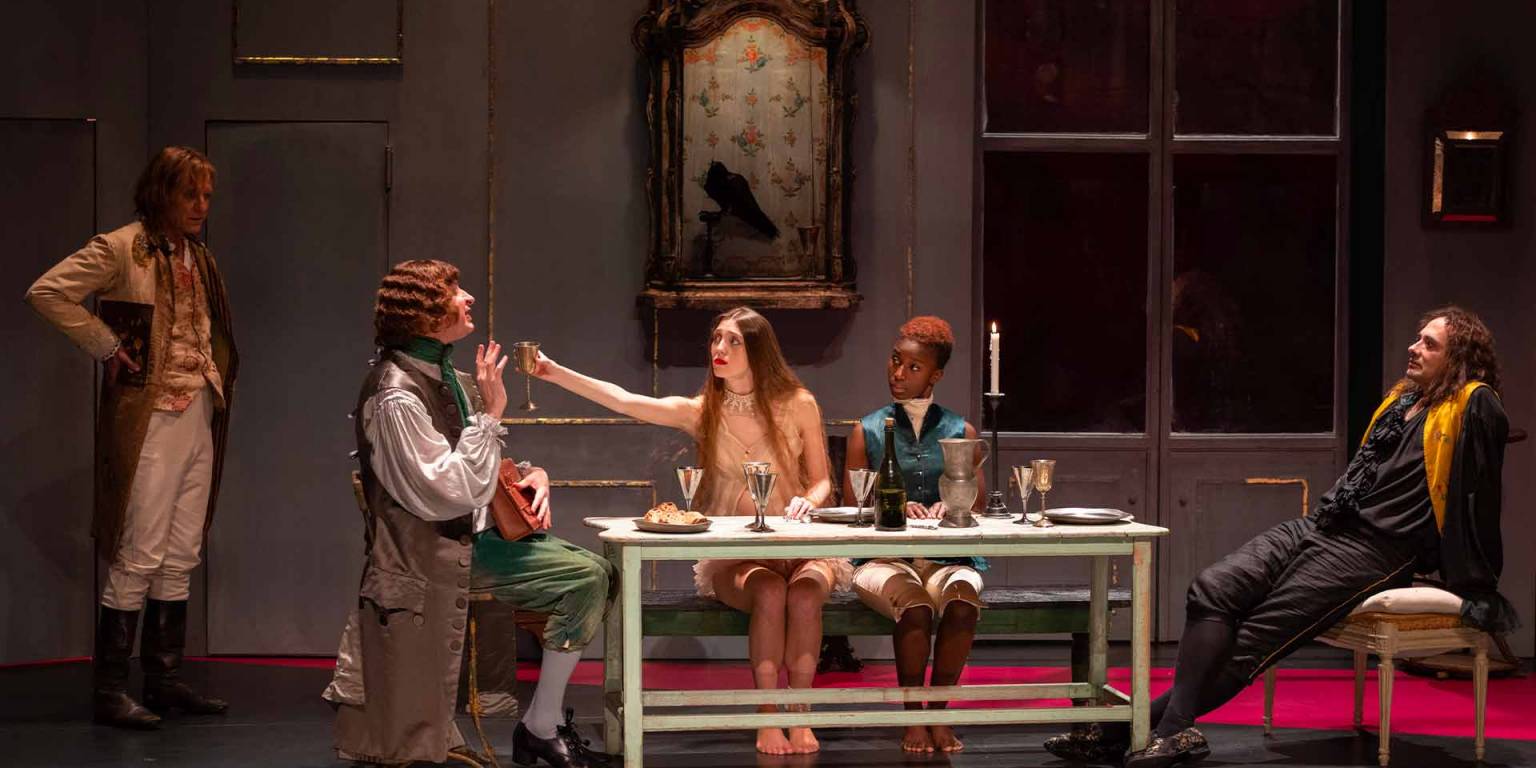
Macha Makeïeff offers the portrait of a Dom Juan cornered and scrutinized by our post-MeToo gaze. The libertine is transposed to the 18th century, into the society of the Ancien Régime which will soon falter. Molière’s dialogues and characters are astonishingly modern. Makeïeff chooses to highlight the duo Dom Juan and Sganarelle, mirroring the Marquis de Sade and his valet Latour, companion in escapades. She wanted a lively Sganarelle, with repartee. The women, notably Elvire, are the heroines of the play.
The obsessive quest for freedom
All the Acts take place in the home of Dom Juan played by Xavier Gallais. It could be a Montpellier Folly built in the 18th century, one of those castles in the Montpellier countryside where the nobility carried out their amorous intrigues out of sight. An imposing French window opens onto a forest which darkens with the incessant coming of danger… Dom Juan is threatened and sought after by his way of life. He seduces, marries and abandons, dishonoring families.
To the sound of the rock band’s electric guitars Lemon twigsthe piece is introduced by a first portrait of the “ big lord bad man “. The debauched master of Sganarelle (Vincent Winterhalter) uses marriage to trap his prey. However, in the 17th century, marriage was sacred, as it was in the 18th century. But that century was that of the Marquis de Sade, a subversive libertine incarcerated, who ended up in the Charenton asylum. Makeïeff wanted Dom Juan locked in his psyche, and to attenuate the religious dimension by transposing the piece to the Age of Enlightenment. Religion, particularly the clergy – the clan of devotees for Molière – will experience its dark hours under the French Revolution.
In the next scene, Dom Juan gets out of bed in the company of a libertine, he appears exhausted and disillusioned. He remains in his long dressing gown – almost ready to let go. For Dom Juan, “ the pleasure of love is in change “. In a sickly way, it causes evil. He tries to give meaning to his existence through the obsessive quest for freedom which he establishes as a new religion, against social dogma.
In Act II, Dom Juan becomes director by the arrival on the set of a troupe of actors: the peasant girls Charlotte (Xaverine Lefebvre) and Mathurine (Vanessa Missé), Pierrot (Joachim Fossi) – Charlotte’s suitor who has just saved Dom Juan and his valet from drowning. Charlotte succumbs, like her rival Mathurine before her. The irony is underlined by the acting of the actors, the silences before certain lines. In seduction, Dom Juan deploys a lot of energy, on the contrary of his posture. Throughout the piece, Sganarelle is more energetic, he jumps, plays the sword, shows wit.
Father’s conviction
The choreographer Guillaume Siard advised on the work on attitudes. The libertines or peasants show their disagreements with subtle gestures of rebellion. They twirl with elegant movements. The 18th century-style wardrobe is partly inspired by dance, with petticoats and leotards. The decor and scenography are the successful components of the play, with a visual and sound progression in the direction of the plot. On the harpsichord, Jeanne Marie Lévy – in the roles of libertine and musician – amazes the audience with her songs and extracts from compositions by Handel and Grétry.
Dom Juan’s compulsive seduction would find its origin in the father’s condemnation and how much he defies God the Father! However, in Act IV on the stage of the Opéra Comédie, the insolent Dom Juan collapses in tears after Dom Luis (Pascal Ternissien) tells him of his shame at having given birth to him. This is one of the aspects highlighted by Makeïeff who was very marked by the violence of this sentence during her high school years.
Elvira (Irina Solvano) is a worthy heroine despite the cowardice of Dom Juan who dodges her questions with his silence, and evades by sending her back to his valet. When she returns, determined to withdraw from the world, but wishing to warn her of the inconsistency of her behavior – her brothers want to assassinate her – he offers to stay. The lovers get closer. But ultimately, Elvire does not give in and screams her refusal. It is enough for her to want to escape or resist for the seducer to fall in love with his prey again. Dom Juan believes he feeds on incessant conquests to satisfy his desires. Sganarelle, his spokesperson who pushes him to confess, witnesses the betrayals. He disapproves and at the same time, he is fascinated. Both are at times complicit in evil. The Poor Man (Anthony Mudir) – in the guise of a thief who sneaked into Dom Juan’s house – is beaten by the duo who force him to swear, in exchange for a golden Louis. Monsieur Dimanche (Pascal Ternissien), whose name could be that of a Balzacian character, fails to recover his debts from the two accomplices. Dom Juan humiliates him and gives him no respite, making it impossible for him to express himself. In the 18th century, the bourgeoisie is the rising class, but Monsieur Dimanche remains hesitant, intimidated by the great lord, awkwardly holding his handbag.
Comedy rubs shoulders with drama, and the unhappiness of a cynical Dom Juan. By his sudden conversion to religious hypocrisy – “ And you think my mouth agreed with my heart? », he says to Sganarelle – he wants to play society in turn and continue to lead his life thanks to the theater of appearances. But it’s too late. At the Commander’s (Xaverine Lefebvre) supper, the worried sound effects mix with a supernatural atmosphere, before the final punishment.
Fatma Alilate
Opera Comedy Montpellier
Dom Juan of Molière
Creation 1665
Staging of Macha Makeïeff
March 5 and March 6 at 8 p.m., March 7, 2026 at 5 p.m.
European City of Theater Domaine d’O Montpellier
With Xavier Gallais : Dom Juan; Vincent Winterhalter : Sganarelle; Irina Solano : Elvira; Pascal Ternisien : Dom Luis, Monsieur Dimanche; Jeanne-Marie Lévy : A libertine, Musician; Xaverine Lefebvre : Charlotte, Libertine, The Commander; Vanessa Missé : Mathurine, Une Libertine ; Joaquim Fossi : Dom Alfonse, Pierrot, Cook; Anthony Moudir : Dom Carlos, Gusman, The Poor Man.
Light Jean Bellorini assisted by Olivier Tisseyre
Son Sébastien Trouvé assisted by Jeremy Tison And Frédéric Guillaume
Makeup and wigs Cécile Kretschmar
Movement Guillaume Siard
Painted canvas (harpsichord) Félix Deschamps Mak
Assistant director Lucile Lacaze
Scenography assistant Nina Coulais
Costume assistant Laura Garnier
Accessories assistant Marine Martin
General management Claire Thiebault-Besombes
Stage management Marine Helmlinger
Props machinist Jeanne Doireau
Costume management Mathilde Boffard
Hair and makeup management Françoise Chaumayrac
Technical intern Joamin Vasseur
Bosio Pavilion Intern Louise Chatelain
Production administration Pauline Ranchin
Production Assistant Mathilde Daudin
Broadcast Pascale Boeglin-Rodier
Set construction and costume making NPT Workshops
Construction of accessories DTMS Machinist Builder of the Jules Verne Professional High School – Sartrouville
Next dates: Opéra Grand Avignon – April 9, La Criée, Marseille – June 4 to 6, 2026…
Travel Source
Discover the world easily and comfortably with Merpati Airlines. From comprehensive travel guides and dream destination recommendations to practical tips, we provide everything you need to plan the perfect trip. Explore exotic locations, find the best deals on flights and hotels, or uncover travel packages tailored to your style. With interactive maps, traveler reviews, and authentic local insights, we’re your trusted travel companion. Start your adventure today!